Sunday, March 18, 2007

More Pictures from St. Louis


The weather in St. Louis was not very good, as you will see in these next few pictures. On our first full day in St. Louis, Nate and I went to the St. Louis Temple and then to the Art Museum. When we were ready to leave we were greeted by a terrific rainstorm. Nate got very wet getting the car.


Then we decided to visit Illinois. The best part of the trip to Illinois was this really great gas station.


The next day, Nate and I decided to go to the zoo even though it was extremely chilly. The St. Louis Zoo has been called one of the best zoos in the country, so we couldn't miss it. But we were very cold.

The animals were cold too. Many of the animals, like the giraffes and this ostrich, were inside.


The camel was so cold that he was foaming.

The polar bear, on the other hand, was perfectly content.

One of the really cool things about the St. Louis Zoo is that it is really old. They still have animals in some of the beautiful historical buildings, like the Herpetarium below.

We will have to go back to the zoo someday when the weather is better.

Monday, March 12, 2007

The City Museum in St. Louis

When we were in St. Louis Nate and I went to one of the most interesting places I've ever seen, The City Museum. The museum is located downtown in the 8-story former International Shoe Company. The museum is really difficult to describe. When I told people about it I said that it was a mixture between a playground and a museum. I think the City Museum website's description is even more accurate: "an eclectic mixture of children's playground, funhouse, surrealistic pavilion, and architectural marvel made out of unique, found objects." The museum is the brainchild of internationally acclaimed artist Bob Cassilly, a classically trained sculptor and serial entrepreneur. He has collected objects (including two abandoned planes, salvaged bridges, old chimneys and bank vault doors) and architectural features from old buildings in St. Louis and assembled them in a truly remarkable way.

The whole time we were at the museum I wished I was a kid. It was so interesting, but it would have been a blast if I were younger. So, Nate and I had a great time climbing around and checking out all the elements of the museum but we mostly used our trip to the museum to take photos. Here they are:

A Collection of Vintage Ties


Nate as a monkey

Bartending

Captured by a Gargoyle
These slides were constructed from the chutes used to get the shoes and shoe boxes from the top floors of the building to the ground floor so they could be shipped and sold. Now the chutes resemble an enormous cavern complete with a dragon.


Sliding down the chutes.

All over the museum are crazy spirals that create alternate routes to the upper floors.

Nate tries to close the door of the vault.


Emerging from the mouth of a fish


The City Museum also has an aquarium in it. The best part about this aquarium is that it is a touching aquarium.

Touching a shark

Climbing through the tunnel beneath the shark tank

Touching the stingrays


The museum also boasts the world's only living, two-headed, albino snake. We posted this picture just for Blake Edwards. Kristen and Cory, as you can see below, the snake is for sale.


Saturday, March 03, 2007

Marble Crazy 2007

Every year at the Moon Marble Company enthusiasts from the Midwest gather to trade, sell, and display their glass creations. The Moon Marble Company is located in the small Kansas town of Bonner Springs, about 20 miles from our home. JoLee and I thought we would pop into their little road side shop/factory for a quick visit, but when we got there we had to park a mile away and shuttle in.


I had no idea that marble making could be so popular. The front shop was loaded with thousands of marbles (and a hundred kids). JoLee and I later bought a few of these small marbles.


The back of the shop was crammed with marble creators who proudly displayed and sold their product. A few demonstrated how marbles were made.


The marbles were stunning, to say the least. They were much more impressive than I anticipated. As one pointed out, glass is one of the oldest man made materials (if not the oldest). As everyone knows, glass is made from sand. The colors in marbles come from various metals in the sand. Due to technological advancements, glass blowers have far more colors to choose from than ever before. Their tools are also more sophisticated. They even use computers to model some of their patterns.

A complex marble can take days to create. Most of the marbles we looked at cost between $50 and $100. However, we saw a number of marbles that cost more than $250, and a few that cost thousands of dollars. Marbles came in all sizes, from a quarter inch to a full foot in diameter.

Below are just a few examples of some types of marbles we saw today. The pictures don't really do them justice, but you'll get the gist.


After ogling over the fancy marbles, JoLee and I picked out a few of the smaller, simple marbles we liked best.

Monday, February 19, 2007

World War I Memorial

Kansas City is home to the Liberty Memorial and National World War I museum. On a very cold Saturday a couple weeks ago, Nate and I made the pilgrimage to this historic site.

Immediately after the armistice of November 11, 1918, a group of Kansas Citians gathered to propose a memorial to the men and women who served in the war and to those who died.

After three years of construction, the completed Liberty Memorial opened on November 11, 1926 –eight years after the end of the War. President Calvin Coolidge delivered the dedication speech, in which he spoke of how "the magnitude of this memorial, and the broad base of popular support on which it rests, can scarcely fail to excite national wonder and admiration." As you can see, the result was this stunning and monumental Art Deco tower that overlooks downtown Kansas City.


The World War I Museum is directly below the Liberty Memorial. To enter the museum you cross this glass bridge over the museum's field of poppies.


The poppy became the emblem of the First World War because of the poppies that bloomed across some of the worst battlefields of Flanders. Their red color is an appropriate symbol for the bloodshed of trench warfare. The poppies also inspired this very famous poem, written in 1917 by John McCrae, who died in the war one year later.

"In Flanders Fields"

In Flanders fields the poppies blow
Between the crosses, row on row
That mark our place; and in the sky
The larks, still bravely singing, fly
Scarce heard amid the guns below.

We are the Dead. Short days ago
We lived, felt dawn, saw sunset glow,
Loved and were loved, and now we lie
In Flanders fields.

Take up our quarrel with the foe:
To you from failing hands we throw
The torch; be yours to hold it high.
If ye break faith with us who die
We shall not sleep, though poppies grow
In Flanders fields.

Here is a photograph of a poppy field in Belgium.


And here is a picture of me from July of 2000, placing a poppy on the grave of an unknown soldier in France.


The museum exhibits contain objects and documents ranging from weaponry and uniforms used during the war, to letters and postcards from the field. The collection is quite extensive. I had been to several World War I museums and memorials when I was studying in Europe, and I think this one is just as good, if not better, than most of the museums I saw there. World War I was the first modern war with modern weaponry - tanks, gas, machine guns, barbed wire, airplanes, etc. The museum has examples of these weapons and explains their use. However, despite the modern weaponry, the war was fought with fairly traditional tactics. After just a few weeks the armies had to dig in and wait out the enemy. Thus began the trench warfare of this war of attrition. In additional to the artifacts and weapons in the museum, there are several recreated trenches that give a first hand look at the experiences of the trenches - the French's trenches were the worst.

I also took this photograph in France. I think I am standing in a trench looking out towards no-man's land. You can see how the land still undulates from the shells and bombs that exploded there almost 100 years ago.


The museum also has a room dedicated to the unfortunate outcomes of the war. Here I am contemplating the sad irony of the "War to End All Wars."

I'll leave you with the words of Wilfred Owen, another war poet who died in 1918 only one week before the Armistice.

"Anthem for Doomed Youth"

What passing bells for those who die as cattle?
Only the monstrous anger of the guns.
Only the stuttering rifles' rapid rattle
Can patter out their hasty orisons.
No mockeries for them from prayers or bells,
Nor any voice of mourning save the choirs,
The shrill, demented choirs of wailing shells;
And bugles calling for them from sad shires.

What candles may be held to speed them all?
Not in the hands of boys, but in the eyes
Shall shine the holy glimmers of good-byes.
The pallor of girls' brows shall be their pall;
Their flowers the tenderness of patient minds,
And each slow dusk a drawing-down of blinds.
- 1917

Tuesday, February 13, 2007

New Blogger

This blog was converted to the new Blogger today. The new Blogger offers a few conveniences that the old one didn't have. In order to post, you'll need to create a Google account if you don't already have one. Creating a Google account is free and simple.

Friday, February 09, 2007

Video Update

Hey everyone, we figured out what was wrong with the videos on the blog. You should be able to watch them now. Please let us know if there are more problems. Sorry!

Tuesday, February 06, 2007

Thomas Hart Benton's Home

On Saturday Nate and I went to tour Thomas Hart Benton's home near downtown Kansas City. Thomas Hart Benton was a Regionalist artist from Missouri whose career spanned from the 1920s to the 1970s.


Last year Nate and I went to see the Thomas Hart Benton's murals in the Missouri State Capital. Thomas Hart Benton's house was really interesting. Benton's house was built in 1905 and the Benton's moved there in 1939 and then lived there until 1975.


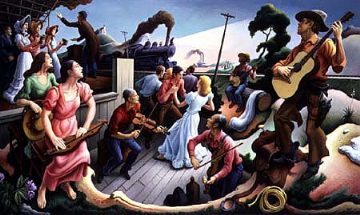
Here are some pictures of us in Benton's studio. Benton converted half of the carriage house into his art studio, which remains as he left it, with coffee cans full of paintbrushes, numerous paints and a stretched canvas waiting to be transformed into another of his masterpieces. Thomas Hart Benton died in his studio on Jan. 19, 1975 painting a mural for the Country Music Hall of Fame.


Here is the work Thomas Hart Benton was working on when he died. He was almost finished, and it now hangs in the Country Music Hall of Fame.


This painting, The Ballad of the Jealous Lover of Lone Green Valley, hangs in KU's museum of art.